Pageviews last month

Thursday, 10 November 2011

Are Child Actors Children for Life?

The stunning and extremely talented Dakota Fanning was recently in a Marc Jacobs ad campaign for the perfume Oh Lola! which received four complaints from British soil and believe it or not, the campaign has been banned!

Seems a bit drastic, and yes I believe it is! When you actually see the full picture (not just the cropped one (above) from The Guardian that makes her look even more provocative, in my opinion) she doesn't look that bad. Yes, the perfume bottle is rested on top of her upper thighs and yes, she is wearing a short, girly looking dress, but to me, it looks perfectly fine; and I studied Media Studies which delves deeply into the interpretation and analysis of ad campaigns!

The thing that annoys me the most (and probably Dakota too) is that she is 17 years old, and turns 18 in February! Now I know she is still classed as a child but at this age, girls all over the UK and USA start experimenting with how they look and start to feel a bit sexy. Yes that sounds a bit bad, but it's true. Especially when you look at the 16 year old school girls, hitching up their skirts and unbuttoning their shirts a bit too low. 

You could argue that the reason girls do this nowadays is the sexualisation of media. More and more people (whether actress or model) dress with minimal clothing, accentuating their 'assets'. But it will still happen. Everything in life seems censored so much, and really, the only place that doesn't get censored is the theatre! Maybe, this is because theatre has been censored so much in the past that people gave up on the regulations because they were so stupid, I don't know, but that's what it feels like with Media.

Child actors like Dakota Fanning, Miley Cyrus and Taylor Momsen have all been in the media over provocative clothing and looking sexy. I say lighten up people! They are young ladies feeling like they should look beautiful and sexy, and if you've got it, flaunt it (appropriately). Are they always going to be the ten year old girls we saw on television and in the movies looking all cute and innocent, no! They want to grow up in the same way as every girl in the world! Being who they want to be, experimenting with their style, having a bit of a rebel to modern society; it's all part of growing up! They'll tone it down when they realise they've grown up!

Here is the quote from the ASA:

The ASA said that the way the perfume bottle rested in Fanning's lap was "sexually provocative" and considered that the actress actually looked to be under the age of 16.

"We considered that the length of her dress, her leg and position of the perfume bottle drew attention to her sexuality," the ASA said.

"Because of that, along with her appearance, we considered the ad could be seen to sexualise a child. We therefore concluded that the ad was irresponsible and was likely to cause serious offence."

I think we need to relax. The picture doesn't look that bad and I think the only reason why we think it looks bad is because we have seen Dakota grow up. She has been a child star from a very early age and we don't realise how old she is now! The girl will be 18 years old in February, will the ban be lifted then? 

I want to hear your ideas on this one because it's a toughy. I want to say yes, this girl should be allowed to pose in anyway she wants to because she is old enough to make her own decisions, but then I want to be mature and say no, she's still underage and she shouldn't be interpreted like this. The picture should not have been banned, that's just ridiculous, but whether or not we want to see girls of this age looking like this is another matter. Please leave feedback!

:D

Wednesday, 9 November 2011

Model Looks

One of the things that has always frustrated me in life is the need to look beautiful. What I mean by this is the obsession we have as a society to look trim, sexy and drop-dead gorgeous, like the girls in fashion magazines. I think the only time I see models that look healthy rather than skeletal is when you look in catalogues for women's clothing sizes 16-22, and the models are still on the small side then. 

In British theatre and film, however, this doesn't seem to be a problem. Notice I said British. Time and time again you see healthy looking actors and actresses perform on stage and film looking as they do, not much trimming down and looking rather confident with themselves, yet across the water, this seems to be forgotten about. I feel there is more of a pressure on young actors and actresses to look a certain way, rather than looking healthy. Take the programme F.R.I.E.N.D.S for example; even though the characters in that show are relatable and lovable, all the actors are still stick thin! If that show was produced in the UK, however, I could almost guarantee there being a slightly chubby character who ends up having a problem with the way they look, but then blossoming out of this feeling and loving who they are (OK that's probably a very shortened version of what would happen, but you catch my drift).

I love seeing curvy, healthy girls on television and thinking "that could be me!" because there doesn't seem to be a lot of pressure in that area, but then if I think about the possibility of being on American television I instantly feel a weight of pressure to look good and look skinny. I've always had a bit of a problem with the way I look (just like so many other women in this world), but seeing curvy actresses on screen actually inspires me more to become an actress and makes me feel good, rather than the stick-thin actresses who are supposed to be there to aspire towards. 

I wish I could get this message across the water to tell people that you don't need plastic surgery to look good! So many models, actors and actresses have completely RUINED their iconic looks and beauty for vanity and the pressure to constantly look beautiful. 

What doesn't help is the new craze of 'reality' television with bimbos and air-headed 'studs' apparently looking "reem" (whatever the **** that means) and saying they're "real" when they obviously are a creation of silicone and liposuction. In my opinion, we need to stop this type of programming getting through to the public, wipe off all that foundation and fake-tan and have a good look at ourselves in the mirror and LOVE what we see. 

Performance is life. You can't get away from it. Why constantly try to be something you're not if your life is one big stage? You are the character of your own little play. Yes, you can mould yourself to be whoever you want to be, but when you start inching away what is part of you, and start feeling the pressure of the need to be skinny and "beautiful", you're just becoming a puppet of social convention. 

As you can see I feel very strongly about this issue, but I want to hear your ideas too. What do you find beautiful? Is there a need to be skinny on stage and film, or can we deal with being curvaceous and lovely? Leave me comments, I would love to hear your thoughts on this!

:D

Tuesday, 8 November 2011

Did you know they've removed the word gullible from the dictionary...?

Derren Brown is someone that annoys me very much. I used to like him; he's entertaining, provides lighthearted jokes and spectacular illusions that you can't quite understand. But that's all they are, illusions, so why do thousands of people get sucked into his acts and believe that he is controlling people and objects with his mind? I'm not one to abandon beliefs of the paranormal because I know some of it is very very hard to explain, but when something is so blatantly staged, why do people believe it?

In terms of the theatre, the act he puts on stage is of a very high standard! You can't see any wires or markers where things are supposed to land etc. and all of his stunts are fluent and believable. Heck, I used to believe them at first, because he is a very clever man. He understands the human mind and how to manipulate it into making people think that illusions are real, but once you see past the smoke and mirrors, it's hard to believe him anymore.

A typical Derren Brown performance entails of audience participation, normally in a theatre or a large space of some sort, and a goal, of which he always achieves. This is fleshed out with videos of him 'manipulating' a 'member of the public' into doing something they either don't want to do, or have 'no idea' of ever doing (a very good example of an actor reading a script). I agree, this is very good entertainment! Believing that someone can control someone else into doing whatever they want is mind blowing, but if this was true wouldn't many more people be able to do this?

I'm starting to lean more into my own opinion now, so lets look at how good of an entertainer Derren is. 

His stage presence is magnificent. Having a following of people that hang onto your every word is a rare thing to have, and he has managed to achieve it with his professional act. I'm not exactly sure how he goes about doing his stunts, and I wouldn't want to ruin it for you anyway, but I do know that they are only stunts. The way he uses video in his live shows almost confirms that he has no 'magical' powers, only the powers of film and television special effects. Most films he makes will have been shot time and time again to get the different camera angles needed to construct an interesting piece of footage, and it is so easy to find a fairly good actor that can pull off a script because of the amount of unknown actors out there. 

He also has a good knowledge of explosive effects (or at least has the contacts to be able to create explosive effects). For example, his recent show involved him playing 'live' Russian Roulette onstage and on live television with a supposedly live round. Just thinking about this stunt flags up so many opportunities he has into creating this stunt safely whilst still making people believe it is happening. Firstly you can buy blank rounds that look like live bullets so even when an unsuspecting audience member is asked to check that the bullet is real, it looks real! But then again, how is an average British person going to know what a live round looks like? Then, when he finally shoots the 'live' round at a sandbag, the sandbag ends up having a bullet hole pierced into it. How does this happen? Film/theatre effects! Little explosives packed into a sandbag to simulate a bullet cutting into them.

Common sense would tell you that Derren Brown is just an illusionist, but yet people are still gullible enough to believe him. Yes, he is entertaining and No, my goal is not to dissuade people against him, but the amount of evidence and common sense there is against him being the real deal is massive. People are so gullible that Jersey police have had to confirm that in his latest performance "There was no live ammunition involved and at no time was anyone at risk" because of complaints that people were leaving with the police (Lenny Harper, Article by Steven Morris, The Guardian, Wednesday 8 October 2003). If you seriously thought that an entertainer was going to threaten his life when he has many more ideas on how to make money out of his talent, then I'm afraid to tell you that you are very gullible. 

I'm sorry if I have offended anyone and I do believe that Derren Brown is a very good entertainer, but that's all I see him as, a very clever entertainer. If you disagree with me please tell me why in the comments because I do want to hear your ideas! If you want to try and convert me into thinking he is the real deal, go ahead! Tell me what you think about him and the use of special effects in theatre and film.

:D

Monday, 7 November 2011

Reality: can it be recreated effectively?

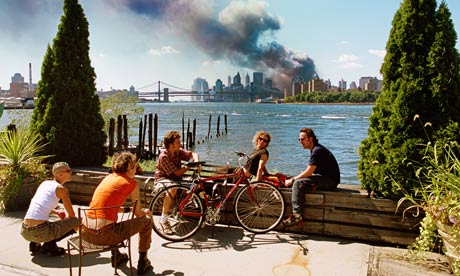
Photograph: Thomas Hoepker/Magnum, 11th September 2001

On reading The meaning of 9/11's most controversial photo by Jonathan Jones (guardian.co.uk, Friday 2 September 2011), I realised how many different ways body language can be read in just a small snapshot of reality. First impressions of the photograph make you think that the group of young adults are just enjoying the sun, casually chatting away and not giving a care in the world as the smouldering ruins of the World Trade Centre lingers in the background; this is what caused such controversy for photographer Thomas Hoepker. My first thoughts on this photo were naïve. Because we are drip-fed stereotypes over the years, my initial thoughts were that these Americans are arrogant and callous, not taking any notice to the horrible scene that is behind them. Then I thought well maybe that's a bit harsh...

Nowadays, with the ever-growing number of photoshopped pictures and photographs, it is hard to find a raw, original copy of a snapshot, which is why my next thought was maybe this photograph is a fake. Was the snapshot of the 'relaxed' group of adults taken before the incident? Was the smouldering skyline added into the picture after to create drama and controversy? Apparently not. Reading through the article by Jones, it states that the people in the picture were "in a profound state of shock and disbelief" (Walter Sipser, 2006). Now, this statement alone puts a whole new meaning to the photograph. It shows us that the apparent casualness of the picture is actually shock. How can we misinterpret that? Is the body language of these two emotions so similar it’s hard to differentiate between the two? Or is it in fact a trick of the eye; seeing a picturesque foreground rudely interrupted by a major international disaster?

"Well, you can't photograph a feeling." - Jonathan Jones, 2011

Now, if I put this into the context of my field of study, we can see a huge problem with displaying true reality on stage, and the re-staging of true events. If we are misinterpreting real life photographs in their original form, how is it even possible to effectively recreate this piece without conforming to naturalism or falling into the trap of over-acting the emotions needed to copy this scene?

If we were to think about re-staging this scene, and the events before and after this snapshot, we would have to consider the underlying emotions: anxiety, shock, disbelief, fear, etc. But how do we convey these emotions to an audience? There are lots of little gestures and behavioural codes to suggest we are shocked, like covering your mouth with your hand and your eyes wide, but as you can see in this photograph no one is doing this! This is because the codes we have learned to identify are drilled into us from day one. We see the staging of a pub brawl on Eastenders or a death on Holby City, but all these programmes are just littered with the conventions of portraying emotions, but in reality, when you are in a true state of shock and disbelief, for example, you go numb and have no idea what to do with yourself.

Would it be sensible to try and mimic real life? If it is so hard to interpret the real emotions behind the people in this photograph, would it be just as hard to transpose it into a live performance and interpret the emotions of the people then?  

Now here is the thing I’m battling in my head… Could we create an effective piece of theatre that mimics the behaviour of the people in this photo as we see them? I’m not sure it would. Obviously, we would understand the scene’s atmosphere straight away if we picked out the essential emotions and emphasized them into a performance, but this would be edging towards naturalism and not a copy of real life. If we copied this scene by every single detail, it might leave audiences feeling confused by the situation, not sure whether the people are shocked, confused or indifferent about the devastation that is happening behind them. We expect, in a theatre frame, to be challenged or entertained in a performance, not to experience daily life, theatre is an escape from that, but still many producers/directors are interested in making theatre as real as it is physically possible.

On the other hand, we encounter similar situations of shock and horror in everyday life (obviously not to the scale of 9/11 but we do), so maybe we would be able to understand this scene, but when you’re in the theatre frame, you interpret things a lot differently to a scene in a site specific performance. Site specific performances can be spontaneous and immersive, therefore you wouldn’t know whether you were watching a performance unless you bought tickets or recognized the conventions of a performance. We could move away from the conventions of a performance (or at least make them subtle) and recreate the scene in question and see what the audiences’ reactions would be. Then, and only then, would it be possible to make a performance look as real as physically possible – avoiding causing an international disaster for the sake of a drama piece – and see if people can tell the difference between real life and performance.

I feel like I’m confusing you now but you understand how complicated it is to try and copy real life situations and put them into a performance. I would love to get a group together and test all this out! (I may do so and update you with my findings!)

Basically, it would be a miracle for a scene like this to be performed and confused for a real life situation. You could take away the scene of the burning skyline, replace it with the new reports from that day and make people think you have just heard the news and are acting accordingly to the behaviour codes of the photograph, but still, could it be good enough to confuse with a true scene?

I want to hear your ideas on this! Can you create an effective piece of theatre in this way? Or is it just physically impossible? Give me your feedback! (Even if it’s several pages long I want to hear it!)

:D